What is the 600 meter run test?
The 600 meter run test measures cardiovascular (aerobic) endurance — how well the heart and lungs keep the body going over a longer effort. Walking is allowed, but a faster time is a better score.
600 Meter Run Test diagram
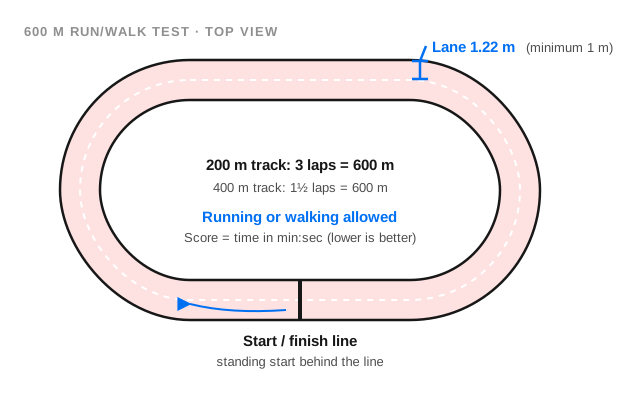
Who takes the 600 meter run test
Age 9–18 — Class 4 to 12.
Equipment
- A 200 m or 400 m track, lane width 1.22 m (minimum 1 m)
- Stopwatch
- Whistle
- Marker cones
- Lime powder
- Measuring tape
600 Meter Run Test procedure
- Students begin from a standing start behind the line.
- Start on the signal “ready, start” and start the watch.
- Students cover 600 m. Walking is allowed, but the aim is to finish in the fastest possible time.
- Stop the watch as each student crosses the finish line and announce the elapsed time to the student.
600 Meter Run Test scoring
- Record the time in minutes, seconds and milliseconds — a lower time is better.
- For ages 14–18 the official benchmark rows are not usable (the printed times are unrealistic and overlapping), so this site shows N/A instead of a level.
Enter the score in the fitness calculator to get the level and points for one student, or use class analysis for a whole class.
Teacher tips
- Small groups make timing easier and more accurate.
- Make sure students warm up and have water available.
How to improve
Activities suggested in the Fit India protocol:
- Pranayam (kapalbhati, bhastrika, bhramari)
- Road cycling
- Swimming
- Aerobics
- Running
- Dancing
600 Meter Run Test norms by age
Score ranges for each level L1–L7, for boys and girls, from the Fit India benchmarks. Points for each level are shown in the header.
Unit: min:sec · Lower is better · Ranges below use the default PDF boundary rule. “—” means no score can reach that level for that age as printed in the PDF.
Boys
| Age | L1Work Harder · 2 pts | L2Must Improve · 4 pts | L3Can Do Better · 6 pts | L4Good · 7 pts | L5Very Good · 8 pts | L6Athletic · 9 pts | L7Sports Fit · 10 pts |
|---|---|---|---|---|---|---|---|
| 9 | ≥ 3:24.6 | ≥ 3:20.4 to < 3:24.6 | ≥ 3:17.4 to < 3:20.4 | ≥ 3:16.2 to < 3:17.4 | ≥ 3:15.6 to < 3:16.2 | ≥ 3:15 to < 3:15.6 | < 3:15 |
| 10 | ≥ 3:28.8 | ≥ 3:22.2 to < 3:28.8 | ≥ 3:17.4 to < 3:22.2 | ≥ 3:15 to < 3:17.4 | ≥ 3:12.6 to < 3:15 | ≥ 3:12 to < 3:12.6 | < 3:12 |
| 11 | ≥ 3:22.8 | ≥ 3:16.2 to < 3:22.8 | ≥ 3:11.4 to < 3:16.2 | ≥ 3:09 to < 3:11.4 | ≥ 3:06.6 to < 3:09 | ≥ 3:06 to < 3:06.6 | < 3:06 |
| 12 | ≥ 3:06 | ≥ 2:52.2 to < 3:06 | ≥ 2:43.2 to < 2:52.2 | ≥ 2:39 to < 2:43.2 | ≥ 2:31.2 to < 2:39 | ≥ 2:30.6 to < 2:31.2 | < 2:30.6 |
| 13 | ≥ 2:14.4 | ≥ 2:08.4 to < 2:14.4 | ≥ 2:04.8 to < 2:08.4 | ≥ 2:03 to < 2:04.8 | ≥ 2:00.6 to < 2:03 | ≥ 2:00 to < 2:00.6 | < 2:00 |
| 14* | N/A — not usable as printed | ||||||
| 15* | N/A — not usable as printed | ||||||
| 16* | N/A — not usable as printed | ||||||
| 17* | N/A — not usable as printed | ||||||
| 18* | N/A — not usable as printed | ||||||
- * PDF row not usable: times of about 1.5 min for 600 m are not realistic and levels overlap.
Girls
| Age | L1Work Harder · 2 pts | L2Must Improve · 4 pts | L3Can Do Better · 6 pts | L4Good · 7 pts | L5Very Good · 8 pts | L6Athletic · 9 pts | L7Sports Fit · 10 pts |
|---|---|---|---|---|---|---|---|
| 9 | ≥ 4:06.6 | ≥ 3:54.6 to < 4:06.6 | ≥ 3:45.6 to < 3:54.6 | ≥ 3:41.4 to < 3:45.6 | ≥ 3:36 to < 3:41.4 | ≥ 3:35.4 to < 3:36 | < 3:35.4 |
| 10 | ≥ 3:57 | ≥ 3:44.4 to < 3:57 | ≥ 3:34.8 to < 3:44.4 | ≥ 3:30.6 to < 3:34.8 | ≥ 3:24.6 to < 3:30.6 | ≥ 3:24 to < 3:24.6 | < 3:24 |
| 11 | ≥ 3:51.6 | ≥ 3:38.4 to < 3:51.6 | ≥ 3:28.8 to < 3:38.4 | ≥ 3:24.6 to < 3:28.8 | ≥ 3:18.6 to < 3:24.6 | ≥ 3:18 to < 3:18.6 | < 3:18 |
| 12 | ≥ 3:24 | ≥ 3:14.4 to < 3:24 | ≥ 3:07.8 to < 3:14.4 | ≥ 3:04.8 to < 3:07.8 | ≥ 3:00.6 to < 3:04.8 | ≥ 3:00 to < 3:00.6 | < 3:00 |
| 13 | ≥ 2:49.8 | ≥ 2:34.8 to < 2:49.8 | ≥ 2:24 to < 2:34.8 | ≥ 2:19.2 to < 2:24 | ≥ 2:12.6 to < 2:19.2 | ≥ 2:12 to < 2:12.6 | < 2:12 |
| 14* | N/A — not usable as printed | ||||||
| 15** | N/A — not usable as printed | ||||||
| 16*** | N/A — not usable as printed | ||||||
| 17**** | N/A — not usable as printed | ||||||
| 18***** | N/A — not usable as printed | ||||||
- * PDF row not usable: copy of Boys age 13 row with overlapping L5/L6.
- ** PDF row not usable: identical to Boys age 14 row (copy error in PDF).
- *** PDF row not usable: identical to Boys age 15 row (copy error in PDF).
- **** PDF row not usable: identical to Boys age 16 row (copy error in PDF).
- ***** PDF row not usable: identical to Boys age 17 row (copy error in PDF).
Source: Fitness Protocols and Guidelines for Age 5-18 Years (v1), Fit India Mission, Ministry of Youth Affairs and Sports, Section 7 Benchmarks, pages 48-57 (baseline reference for academic year 2020-21). Values verified against the PDF.
600 Meter Run Test for Class 11 and 12 Physical Education
Students in Class 11 and 12 Physical Education often record this test in their practical file. A complete write-up ofthe 600 meter run test has the aim, the equipment, the procedure, a labelled diagram (you can redraw the one above), the scoring method and your own result with its level from the norms table.
For all the tests on one page, see the printable practical file summary on the SAI Khelo India Fitness Test page.
Frequently asked questions
Is the 600 m test a run or a walk?
Both are allowed. Students may walk part of the distance, but the aim is to cover 600 m in the fastest possible time.
Why does my 15-year-old get N/A?
The official PDF rows for ages 14–18 contain copy errors and overlapping times. Rather than guess a level, the tool shows N/A with a note. You can still record the time for your own tracking.
How do I write up the 600 meter run test in a Class 12 Physical Education practical file?
Write the aim (what the 600 meter run test measures), the equipment, the procedure step by step, a labelled diagram, how it is scored, and your own result with the level from the norms table. The SAI Khelo India Fitness Test page has a printable summary of every test.