SAI Khelo India Fitness Test: Tests, Levels and Scoring
A plain guide to the school fitness test battery for students aged 5 to 18: which tests each class takes, what every test measures, how scores become levels L1–L7 and points, and a printable summary for your Physical Education practical file.
Disclaimer: This is an independent, free tool. It is not affiliated with, endorsed by or operated by the Sports Authority of India, Khelo India or the Fit India Mission.
What is the SAI Khelo India Fitness Test?
The SAI Khelo India Fitness Test is the school fitness test battery for students aged 5–18 described in the Fit IndiaFitness Protocols and Guidelines for Age 5–18 Years. In the CBSE Physical Education (048) syllabus for Class 11 and 12, this battery is called the SAI Khelo India Fitness Test, with the same age groups and tests shown on this page.
It is a battery of simple field tests: each one checks a different part of fitness — body composition, balance, coordination, flexibility, strength, speed and endurance — using equipment most schools already have.
Scores are compared with age- and gender-wise benchmarks. Each result is placed on one of seven levels, so a teacher, a student or a parent can see at a glance where a child is strong and what needs work.
About the SAI Khelo India fitness test age groups
The battery has two age groups. BMI is measured for every student; the other tests depend on the age group.
Age group
Classes
Tests
5–8 years
Class 1–3
BMI, Plate Tapping, Flamingo Balance
9–18 years
Class 4–12
BMI, Partial Curl-up, Push-ups (modified for girls), Sit and Reach, 600 m Run/Walk, 50 m Dash
Every test and what it measures
Open any test for the full procedure, a labelled diagram and the norms table for boys and girls.
Every test score is compared with the benchmark for the student’s age in completed years andgender. The score falls into one of seven levels, and each level is worth a fixed number of points:
L1 · 2 ptsWork Harder
L2 · 4 ptsMust Improve
L3 · 6 ptsCan Do Better
L4 · 7 ptsGood
L5 · 8 ptsVery Good
L6 · 9 ptsAthletic
L7 · 10 ptsSports Fit
For counts and distances (curl-ups, push-ups, sit and reach) a higher score is better.
For times and falls (plate tapping, flamingo balance, 600 m, 50 m) a lower score is better.
Total points add up the points from every test that has a level. BMI is a category (Underweight, Normal, Overweight or Obese) and adds no points.
For the 600 m Run/Walk at ages 14–18 the printed benchmark rows are not usable, so this site shows N/A instead of guessing a level.
SAI Khelo India fitness test for Class 11 and Class 12
The CBSE Physical Education (048) senior secondary syllabus includes this battery in two places:
The Class 11 and Class 12 practicals list “Physical Fitness Test: SAI Khelo India Test”.
Class 12 Unit VI lists “Fitness Test – SAI Khelo India Fitness Test in school”, with the same age groups and tests.
Students in Class 11 and Class 12 are in the 9–18 years group. They take BMI and five tests: Partial Curl-up, Push-ups, Sit and Reach, 600 m Run/Walk and 50 m Dash. For the practical file, each test needs its aim, equipment, procedure, diagram and scoring; the printable summary below has all of these.
Ideas for a SAI Khelo India fitness test project
Test yourself at the start and end of a term and compare levels on the progress page.
With your teacher’s permission, record results for a group in the Excel template and use class analysis to see how many students reached each level.
Pick your weakest test and follow the improvement activities listed on that test’s page for a few weeks.
Printable
SAI Khelo India fitness test practical file summary
One block per test with the aim, equipment, procedure, scoring and diagram. Print it, or copy it by hand into your Physical Education practical file and add your own results.
BMI for Children
Age 5–18 · Body composition
Aim: BMI for children is a quick screen of body composition: weight relative to height. Because children grow, the same BMI means different things at different ages, so the result is read against the norms for the child’s age and gender rather than a single adult cutoff.
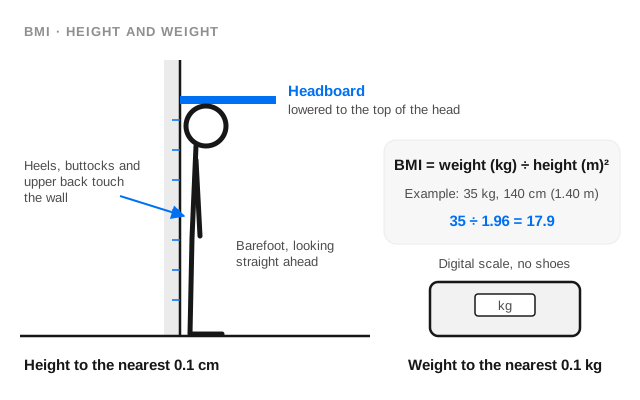
Equipment: Stadiometer or a measuring tape fixed vertically to a flat wall; Digital weighing scale (not a spring bathroom scale), checked against a known weight; Record sheet or the Fitness Report Card template.
Procedure:
Height: the student stands barefoot with heels, buttocks and upper back touching the wall, looking straight ahead. Lower a flat headboard to the top of the head and record the height to the nearest 0.1 cm.
Weight: the student stands still in the centre of the digital scale in light clothing, without shoes. Record the weight to the nearest 0.1 kg.
BMI = weight (kg) ÷ height (m)². For example, 140 cm is 1.40 m.
Round BMI to one decimal and look up the category for the student’s age (completed years) and gender.
Scoring: BMI is reported as a category — Underweight, Normal, Overweight or Obese — not as a level L1–L7. The table also shows the reference median BMI for each age. It is a guide, not a cutoff.
My result: ____________ Level: ______
Plate Tapping Test
Age 5–8 · Speed of limb movement & coordination
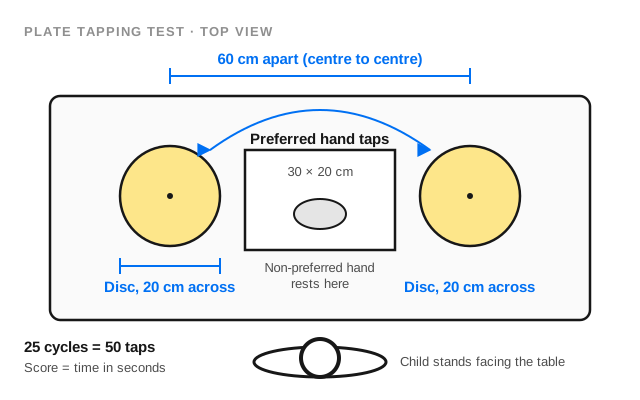
Aim: The plate tapping test measures how quickly a child can move one hand back and forth between two targets while the other hand stays still. It reflects speed of limb movement and hand–eye coordination.
Equipment: Table with adjustable height; Two yellow discs, 20 cm in diameter, with their centres 60 cm apart; A 30 × 20 cm rectangle placed midway between the two discs; Stopwatch.
Procedure:
The child stands facing the table with feet slightly apart.
The non-preferred hand rests on the rectangle in the middle. The preferred hand is placed on the disc on the opposite side.
On “Go”, the child moves the preferred hand back and forth between the two discs as fast as possible, over the resting hand.
The child completes 25 full cycles (50 taps). Stop the watch at the end of the 25th cycle.
Scoring: Score is the time in seconds taken to complete 25 cycles — a lower time is better. Enter the time with one or two decimals, e.g. 14.25.
My result: ____________ Level: ______
Flamingo Balance Test
Age 5–8 · Static balance
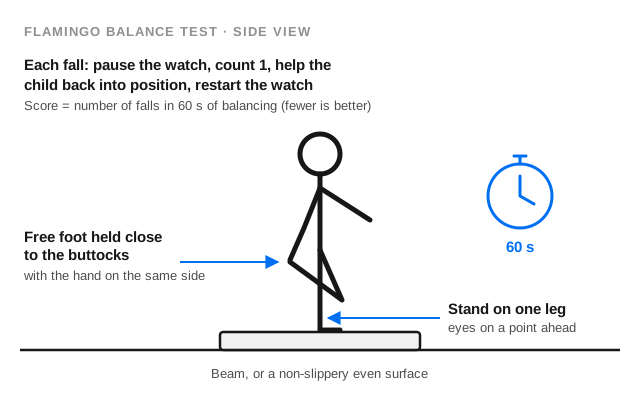
Aim: The flamingo balance test measures static balance: how well a child can hold a still position on one leg. The fewer times the child loses balance in 60 seconds, the better the score.
Equipment: A beam, or a non-slippery even surface; Stopwatch.
Procedure:
The child stands on one leg. The free leg is bent at the knee and the foot is held close to the buttocks with the hand on the same side, like a flamingo.
The child may hold the instructor’s hand to get balanced. Start the watch when the instructor lets go.
Each time the child falls (falls off the beam or lets go of the held foot), pause the watch and count one fall. Help the child back into position and resume the watch.
Continue until a total of 60 seconds of balancing has been completed.
If the child has more than 15 falls in the first 30 seconds, the test is terminated.
Scoring: Score is the number of falls in 60 seconds of balancing — fewer falls is better.
My result: ____________ Level: ______
Partial Curl Up Test
Age 9–18 · Abdominal strength & endurance
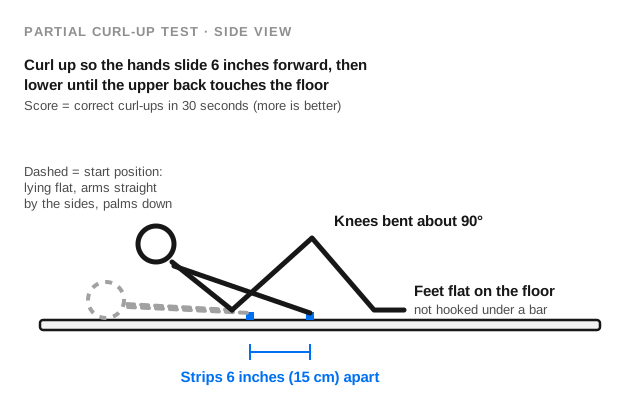
Aim: The partial curl up test measures the strength and endurance of the abdominal (stomach) muscles. A curl-up only counts when the hands slide the full 6 inches and the upper back returns to the floor.
Equipment: Cushioned, flat surface with two parallel strips 6 inches (about 15 cm) apart; Stopwatch; A partner to count.
Procedure:
The student lies on their back with knees bent at about 90°, feet flat on the floor and arms straight by the sides with palms facing down.
On “Go”, the student curls up so that the hands slide along the ground at least 6 inches (about 15 cm) towards the parallel strip.
The student then lowers back until the shoulder blades / upper back touch the floor.
Repeat at a steady pace for 30 seconds. Count only curl-ups done with the correct form.
Scoring: Score is the number of correct curl-ups in 30 seconds — more is better.
My result: ____________ Level: ______
Push Up Test
Age 9–18 · Upper-body strength & endurance
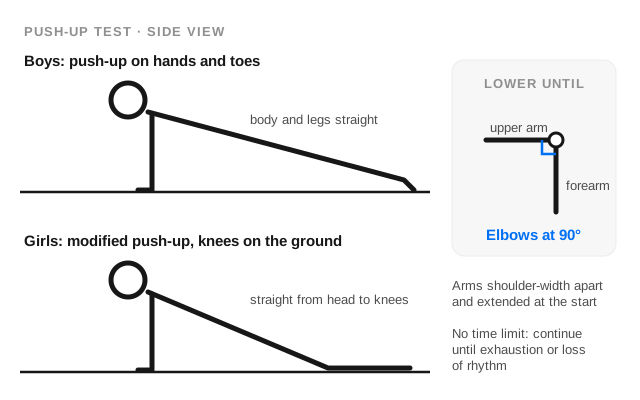
Aim: The push up test measures the strength and endurance of the arms, shoulders and chest. Only push-ups with a straight body and elbows bent to 90° are counted.
Equipment: Mat or flat surface; A partner or teacher to count.
Procedure:
Boys: start with hands and toes on the floor, body and legs straight, feet slightly apart, and arms shoulder-width apart and extended.
Girls (modified): same technique, but with the knees on the ground.
Lower the body until the elbows are at 90°, then return to straight arms.
There is no time limit. Continue until exhaustion, until the student can no longer keep the rhythm, or until the target number is reached.
Scoring: Score is the number of correct push-ups — more is better.
My result: ____________ Level: ______
Sit and Reach Test
Age 9–18 · Flexibility
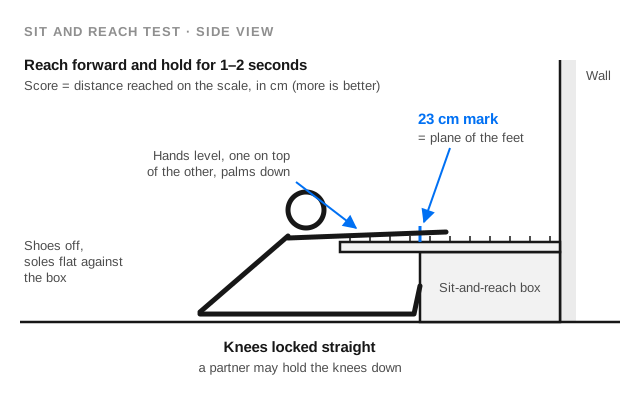
Aim: The sit and reach test measures flexibility — mainly of the lower back and the hamstrings (the muscles at the back of the thigh). It is the flexibility test in the Fit India battery.
Equipment: Sit-and-reach box: sides 12" × 12", front and back 12" × 10", top 12" × 21" with centimetre gradations; A wall to place the box against.
Procedure:
Place the box against a wall. The plane of the feet must be exactly at the 23 cm mark of the box.
The student removes shoes and sits with the soles of the feet flat against the box and the knees locked flat. A partner may hold the knees down.
Palms face down, one hand on top of the other, with the hands level.
After a few practice reaches, the student reaches forward as far as possible and holds the position for 1–2 seconds, without jerking, while the distance is read.
Repeat the trial if the hands are uneven or the knees bend.
Scoring: Score is the distance reached in centimetres — more is better.
My result: ____________ Level: ______
600 Meter Run Test
Age 9–18 · Cardiovascular endurance
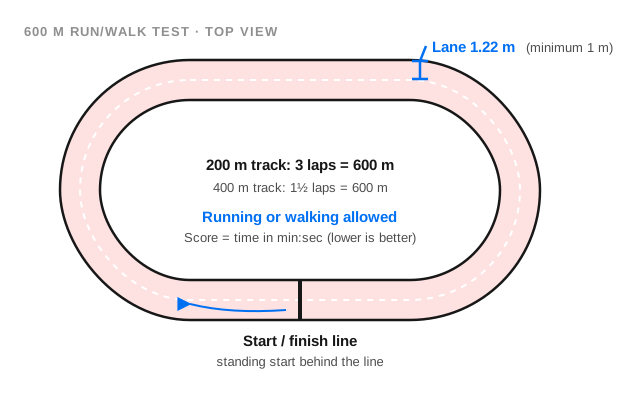
Aim: The 600 meter run test measures cardiovascular (aerobic) endurance — how well the heart and lungs keep the body going over a longer effort. Walking is allowed, but a faster time is a better score.
Equipment: A 200 m or 400 m track, lane width 1.22 m (minimum 1 m); Stopwatch; Whistle; Marker cones; Lime powder; Measuring tape.
Procedure:
Students begin from a standing start behind the line.
Start on the signal “ready, start” and start the watch.
Students cover 600 m. Walking is allowed, but the aim is to finish in the fastest possible time.
Stop the watch as each student crosses the finish line and announce the elapsed time to the student.
Scoring: Record the time in minutes, seconds and milliseconds — a lower time is better. For ages 14–18 the official benchmark rows are not usable (the printed times are unrealistic and overlapping), so this site shows N/A instead of a level.
My result: ____________ Level: ______
50 Meter Dash Test
Age 9–18 · Speed
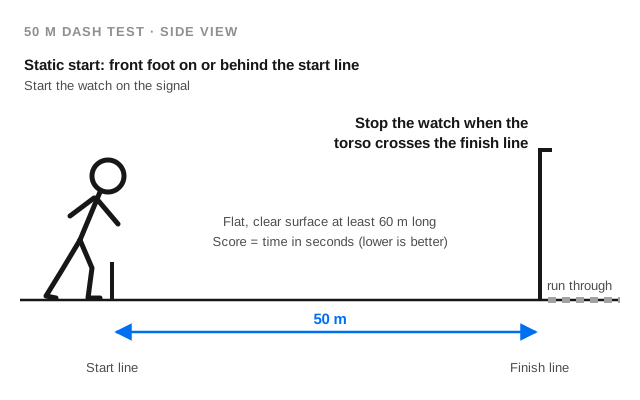
Aim: The 50 meter dash test measures speed — how quickly a student can sprint a short, straight distance from a standing start.
Equipment: A flat, clear surface at least 60 m long; Stopwatch (accurate to 0.1 s); Start and finish markers.
Procedure:
Students do a thorough warm-up, including some practice starts.
The student takes a static (“dead”) start with one foot in front of the other; the front foot must be on or behind the start line.
On the signal, start the watch; the student sprints through the finish line. The tester encourages the student to stay low, drive the arms and legs, and run hard through the finish.
Stop the watch as the student’s torso crosses the finish line.
Scoring: Score is the time in seconds — a lower time is better.
My result: ____________ Level: ______
Source: Fitness Protocols and Guidelines for Age 5-18 Years (v1), Fit India Mission, Ministry of Youth Affairs and Sports, Section 7 Benchmarks, pages 48-57 (baseline reference for academic year 2020-21). This is an independent, free tool. It is not affiliated with, endorsed by or operated by the Sports Authority of India, Khelo India or the Fit India Mission.
Frequently asked questions
What is the SAI Khelo India Fitness Test?
It is the school fitness test battery for students aged 5–18 set out in the Fit India Fitness Protocols and Guidelines. In the CBSE Physical Education (048) syllabus for Class 11 and 12, this battery is called the SAI Khelo India Fitness Test. Students aged 5–8 take BMI, Plate Tapping and Flamingo Balance; students aged 9–18 take BMI, Partial Curl-up, Push-ups, Sit and Reach, 600 m Run/Walk and 50 m Dash.
Which tests do Class 11 and Class 12 students take?
The CBSE Physical Education (048) Class 11 and 12 practicals list “Physical Fitness Test: SAI Khelo India Test”. Class 11 and 12 students fall in the 9–18 years group, so they take BMI, the Partial Curl-up test, Push-ups (modified push-ups for girls), Sit and Reach, the 600 m Run/Walk and the 50 m Dash.
How is the SAI Khelo India fitness test scored?
Each test score is placed on a level from L1 (Work Harder) to L7 (Sports Fit) using the benchmarks for the student’s age and gender. Each level carries points, from 2 for L1 to 10 for L7. BMI is shown as a category and does not add points.
What should a SAI Khelo India fitness test practical file include?
For each test: the aim (what it measures), equipment, procedure, a labelled diagram, the scoring method and your own result with its level. The printable summary on this page covers all of these.
Is this the official SAI or Khelo India website?
This is an independent, free tool. It is not affiliated with, endorsed by or operated by the Sports Authority of India, Khelo India or the Fit India Mission.